
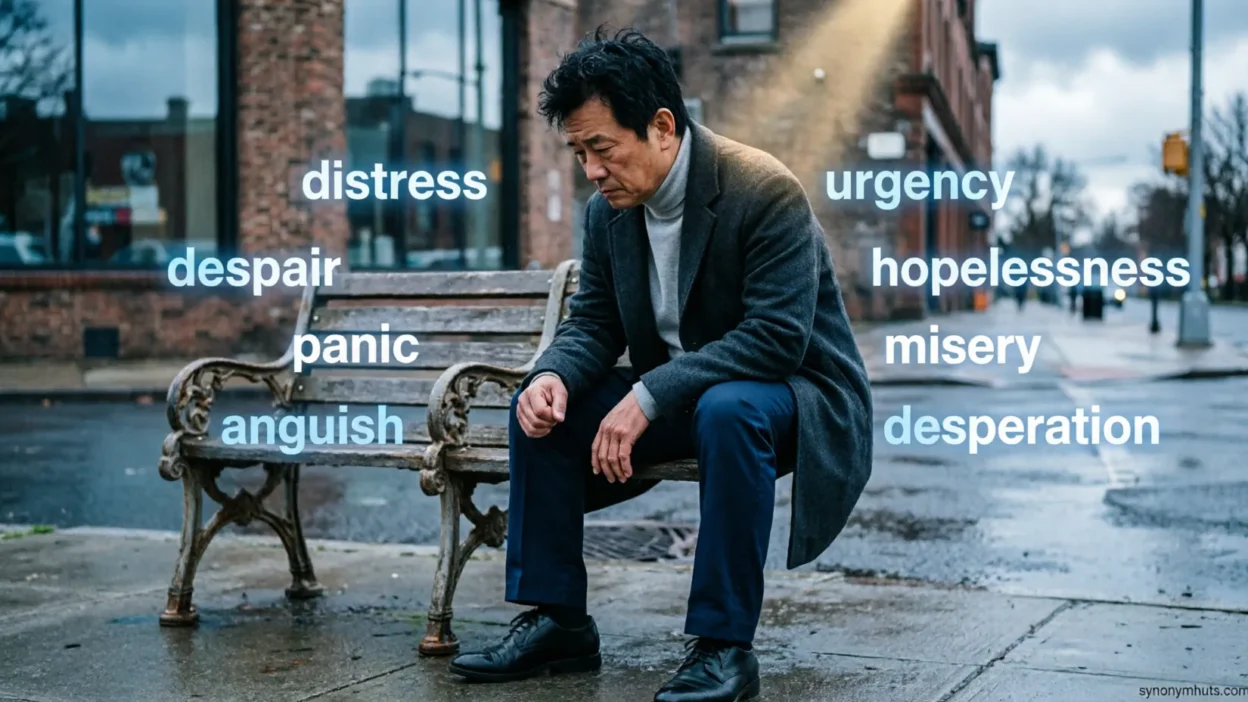
The phrase synonyms for desperation is useful for students, writers, ESL learners, and anyone who wants to express emotions more accurately.
While desperation describes a feeling of having little or no hope, many other words can communicate similar emotions with different levels of intensity.
Learning these alternatives helps improve vocabulary, avoid repetition, and make your writing more expressive. Some words fit emotional situations, while others work better in formal, literary, or everyday conversations.
What Does “Desperation” Mean?
Simple Meaning
Desperation is a strong feeling of hopelessness or urgent need when someone believes there is no easy solution to a problem.
It often describes people who are:
- Feeling trapped
- Running out of options
- Extremely worried
- Willing to take risks because they see no other choice
Usage Context
You can use desperation when talking about:
- Emotional struggles
- Financial hardship
- Emergency situations
- Relationships
- Survival
- Difficult life decisions
Example:
“In her desperation, she accepted the first job she could find.”
30 Synonyms for Desperation
1. Hopelessness
Meaning: Feeling that nothing will improve.
Example: Hopelessness filled his heart after hearing the bad news.
Best Usage Context: Emotional or mental situations.
2. Despair
Meaning: Complete loss of hope.
Example: She cried in despair after losing everything.
Best Usage Context: Serious emotional writing.
3. Distress
Meaning: Great pain, worry, or sadness.
Example: The family was in distress after the accident.
Best Usage Context: Formal and everyday English.
4. Misery
Meaning: Extreme unhappiness.
Example: Years of poverty brought endless misery.
Best Usage Context: Emotional descriptions.
5. Anguish
Meaning: Deep emotional suffering.
Example: He spoke with obvious anguish.
Best Usage Context: Literature and emotional stories.
6. Agony
Meaning: Intense physical or emotional pain.
Example: Waiting for the results was pure agony.
Best Usage Context: Strong emotional experiences.
7. Suffering
Meaning: Going through pain or hardship.
Example: Many families are suffering during difficult times.
Best Usage Context: General writing.
8. Anxiety
Meaning: Strong worry about the future.
Example: Financial anxiety kept her awake.
Best Usage Context: Mental health and daily conversations.
9. Panic
Meaning: Sudden fear causing rushed actions.
Example: People ran in panic during the storm.
Best Usage Context: Emergencies.
10. Fear
Meaning: Feeling afraid.
Example: Fear stopped him from speaking.
Best Usage Context: Everyday English.
11. Helplessness
Meaning: Feeling unable to change a situation.
Example: She watched with helplessness.
Best Usage Context: Emotional writing.
12. Urgency
Meaning: Need for immediate action.
Example: There was urgency in his voice.
Best Usage Context: Business and emergencies.
13. Neediness
Meaning: Strong need for help or attention.
Example: His neediness became obvious.
Best Usage Context: Relationships.
14. Crisis
Meaning: A serious and dangerous situation.
Example: The company faced a financial crisis.
Best Usage Context: News and business.
15. Hardship
Meaning: Difficult living conditions.
Example: They survived years of hardship.
Best Usage Context: Life challenges.
16. Trouble
Meaning: Problems or difficulties.
Example: She was in serious trouble.
Best Usage Context: Everyday conversation.
17. Difficulty
Meaning: Something that is hard to deal with.
Example: They experienced financial difficulty.
Best Usage Context: General English.
18. Misfortune
Meaning: Bad luck or unfortunate events.
Example: A series of misfortunes changed his life.
Best Usage Context: Storytelling.
19. Wretchedness
Meaning: Extreme unhappiness or poor conditions.
Example: They lived in wretchedness.
Best Usage Context: Formal writing.
20. Desolation
Meaning: Feeling completely empty and lonely.
Example: The empty house reflected her desolation.
Best Usage Context: Literary English.
21. Frustration
Meaning: Feeling upset because something is difficult.
Example: His frustration continued to grow.
Best Usage Context: Daily conversations.
22. Vulnerability
Meaning: Being open to harm or danger.
Example: Children need protection because of their vulnerability.
Best Usage Context: Emotional discussions.
23. Exhaustion
Meaning: Extreme physical or mental tiredness.
Example: Exhaustion affected every decision.
Best Usage Context: Health and work.
24. Defeat
Meaning: Feeling beaten or unsuccessful.
Example: She refused to accept defeat.
Best Usage Context: Sports and life challenges.
25. Despondency
Meaning: Low spirits and loss of hope.
Example: Months of unemployment caused despondency.
Best Usage Context: Formal writing.
26. Depression
Meaning: Deep sadness over a long period.
Example: He struggled with depression.
Best Usage Context: Mental health discussions.
27. Isolation
Meaning: Being separated from others.
Example: Isolation increased his sadness.
Best Usage Context: Social situations.
28. Insecurity
Meaning: Lack of confidence or safety.
Example: Financial insecurity worried the family.
Best Usage Context: Personal development.
29. Desolation
Meaning: Extreme loneliness and sadness.
Example: The abandoned village showed complete desolation.
Best Usage Context: Descriptive writing.
30. Last Resort
Meaning: The final option after everything else fails.
Example: Selling the house became their last resort.
Best Usage Context: Decision-making situations.
Comparison Guide: When to Use Different Synonyms
| Synonym | Best Used For | Tone |
|---|---|---|
| Despair | Complete loss of hope | Very Strong |
| Hopelessness | Emotional sadness | Strong |
| Distress | Worry and suffering | Formal |
| Panic | Sudden fear | Urgent |
| Anxiety | Constant worry | Everyday |
| Agony | Extreme pain | Dramatic |
| Hardship | Difficult life conditions | Neutral |
| Crisis | Serious situations | Formal |
| Helplessness | No control | Emotional |
| Last Resort | Final choice | Practical |
How to Choose the Right Synonym
For Emotional Writing
Use:
- Despair
- Anguish
- Agony
- Hopelessness
- Desolation
These words create powerful emotional impact.
For Everyday Conversations
Choose:
- Trouble
- Difficulty
- Anxiety
- Fear
- Frustration
These sound natural in daily English.
For Formal Writing
Good choices include:
- Distress
- Crisis
- Hardship
- Despondency
- Vulnerability
These are suitable for essays, reports, and academic writing.
For Stories and Creative Writing
Use:
- Misery
- Wretchedness
- Isolation
- Despair
- Agony
These words help readers feel stronger emotions.
For Business or Professional Writing
Better options include:
- Crisis
- Urgency
- Difficulty
- Hardship
- Distress
These maintain a professional tone.
Common Examples Using Synonyms for Desperation
- The team’s desperation became obvious in the final minutes of the game.
- Her despair was clear after the disappointing results.
- Financial hardship forced the family to move.
- Panic spread quickly through the crowd.
- Anxiety made it difficult to concentrate.
- Helplessness filled the room during the emergency.
- The crisis required immediate action.
- After months of struggle, selling the business became their last resort.
Common Mistakes to Avoid
Do not use every synonym interchangeably.
Although many words are related, each has a slightly different meaning.
For example:
- Panic means sudden fear.
- Despair means complete loss of hope.
- Urgency focuses on immediate action.
- Hardship describes long-term difficulties.
Choosing the right word makes your writing more accurate and natural.
Why Learning Synonyms for Desperation Matters
Expanding your vocabulary offers several benefits:
- Makes your writing more engaging.
- Helps avoid repeating the same word.
- Improves speaking confidence.
- Creates clearer emotional descriptions.
- Strengthens essays, stories, and articles.
- Helps ESL learners understand subtle differences between similar words.
If you’re writing a school assignment, blog post, novel, or business document, knowing multiple synonyms for desperation allows you to communicate your ideas more effectively.
Conclusion
Understanding synonyms for desperation helps you express feelings of hopelessness, urgency, fear, and emotional struggle with greater precision. While desperation remains the most direct term, alternatives like despair, hopelessness, distress, panic, hardship, and last resort each add their own unique meaning and tone.
By learning when to use each synonym, you’ll improve your vocabulary, write more naturally, and communicate with greater confidence in both everyday and professional English.

Abigail Alice is a passionate language writer and content creator at SynonymHuts.com, specializing in synonyms, vocabulary, word meanings, grammar tips, and easy-to-understand language resources for students, writers, and English learners.